

Case Study: Arclet
- Case Studies >
- Arclet
Building a two-part lead engine for a public health startup
Arclet came to Jasz Rae Digital with a strong product, a tight budget, and a hard-to-reach audience. This is the story of a two-part lead engine: a high-intent campaign that filled the demo pipeline with qualified leads, a broad campaign that filled the top of the funnel with the right people, and the email nurture flows that connect them.
About Arclet
Arclet is a public health technology startup with a social mission. Founded by Adrienne Ammerman and built from real cross-sector community health work in rural Western North Carolina, the platform helps local, regional, and state health messengers find vetted, evidence-based health messaging, customize it to be culturally relevant, gather community feedback, publish to their social channels, and measure impact. Its focus is the under-resourced but trusted local messengers who keep their communities healthy and safe. Arclet supports teams across 26 states, received a National Science Foundation grant for its AI work, and offers a 30-day free trial that leads into paid subscriptions.
The challenge: why Arclet came to Jasz Rae Digital
Arclet had a strong mission and a strong product, but a familiar problem underneath it: how to turn a tight budget into paying customers. The team had, by their own account, erred on the side of spending almost nothing. They needed a partner who would treat every dollar as an ROI decision and help them figure out where scarce money would do the most good.
Three things made it hard. First, the buyer is genuinely hard to reach. Arclet's beachhead is local and state public health departments: career government communicators who are innovation-averse, stretched thin, and, as the team put it, mostly not hustling on LinkedIn. Second, the founder's time is the scarcest resource of all. Adrienne is Arclet's only founder and its public voice, and nearly every growth idea on the table depended on her hours. The working hypothesis: local health communicators are on Facebook and Instagram, because posting community health content is literally their job.
The strategy: two campaigns, two jobs
Because the buyers were not active on LinkedIn but were likely working inside Facebook and Instagram all day, the marketing plan met them there, on the channels Arclet had not yet used. The whole approach was built to be light on the founder's time, with strategy, implementation, creative, and direction from Jasz Rae Digital.
Campaign one led with a high-intent offer, inviting people toward a webinar and a demo of the platform. It brought in qualified, demo-ready leads: fewer in number and higher in cost, but exactly the kind of prospect Arclet wants in a sales conversation. Just as important, we built the email nurture flows to carry these leads toward a demo and a free trial, and coached the team on how to work them, so the pipeline had somewhere to go from day one.
Campaign two widened the top of the funnel with a free, editable Canva health template offer, delivered through a Facebook instant form. It brought in far more leads at a much lower cost, and it was strategically self-selecting: the people who want ready-to-use social graphics are the people who manage social media for their health organizations, which is exactly Arclet's ideal user. Because the nurture flows were already in place, these new contacts immediately had a path toward the webinar, a demo, and the free trial.
Across both, the messaging spoke to overwhelm and time, not software features, with lines like “Running social media wasn't supposed to be your full-time job” and “A week's worth of health content in minutes.” Six ad concepts were designed and tested against each other, favoring native, scroll-stopping creative over polished, corporate visuals.
The results
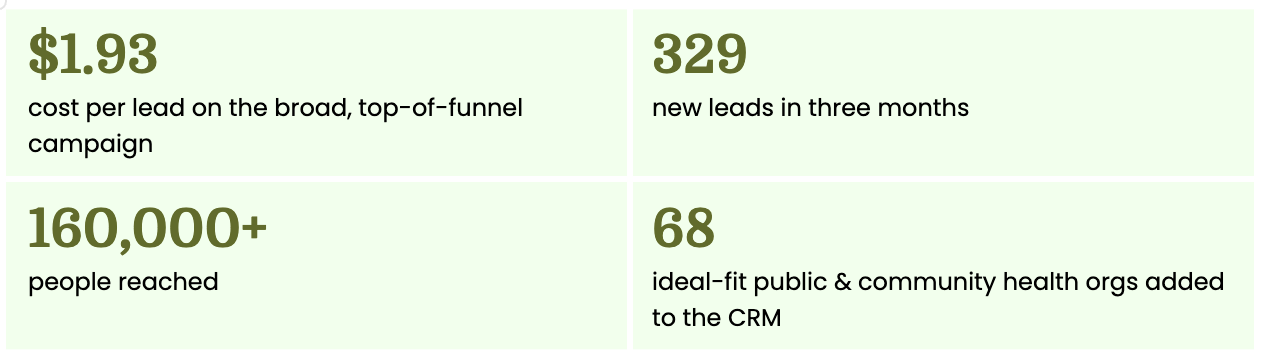
Together, the two campaigns gave Arclet both quality and scale. The first brought in qualified, demo-ready leads, plus the nurture flows to convert them. The second reached more than 160,000 people and brought in 329 new leads at $1.93 each on the top-of-funnel offer now sitting in Arclet's CRM and moving through nurture toward a demo or a free trial.
Why it worked
Two things made it work. First, the offers did different jobs on purpose. A high-intent webinar and demo campaign brings in fewer, higher-quality leads, while a free, useful offer lowers the barrier and brings in many more. Run together, with nurture flows in between, Arclet got quality and reach instead of having to choose. Second, the free offer was a filter as much as a magnet: by giving away social media templates, the campaign naturally attracted the people who run social media for health organizations, the exact audience Arclet is built for.
What's next
With qualified contacts in the CRM and targeting refined, the focus now shifts to nurturing those leads toward demos and 30-day free trials, and continuing to sharpen acquisition so more of every dollar reaches Arclet's core audience.

“Jasz Rae Digital built us a real system, not just ads. The first campaign brought in qualified, demo-ready leads and the email flows to nurture them. The second filled the top of our funnel with hundreds of the right people, the social media managers at health organizations we are built for, and fed them into that same pipeline. For the first time, our marketing has both quality and reach, and it is working as hard as we do.”
Lets get in touch!
Ready to Transform Your Marketing & Sales Operations?
If you're not getting the most from HubSpot, struggling with email engagement, or need a strategic partner who can own your marketing technology stack, let's talk.